Wednesday, February 25, 2009

America lives under the lights, blinding ones.


In American culture, we value aspects of our lives that cause us to be ostracized on the world stage. We are blunt, busy, and breathtakingly over the top. As an American, I take luxuries and abnormal U.S. habits for granted every single day. Here are just a few.

As a people, we block out our days like it's our job. No time to relax or regroup. A moment spent on the couch or in a bed are seen as simply a waste. In most of the world, you might come back from the market on a scenic road on the outskirts of town. In the states, we use Map Quest. The site simply finds the fastest route possible. We pay our psychologists and baseball trainers by the hour. We pay for food to be served to us within a few minutes of the order. These are all normal, day-to-day American activity that we find no qualms with. Much of the world is shocked.

Achievements make or break every American's day. It's not our fault that we have developed this habit of constant forward thinking, but society has demanded it. We spend every second looking towards the future, eager to conquer the goals laid in front of us, like a carrot on a stick. We are taught that the pursuit of goals results in a "successful" life. A simple life, with a garden and a nice little house, does not do it these days. We need mansions and six figure incomes to be "successful". This is why the world thinks we're crazy and infatuated with ourselves, because we are.

Thursday, February 19, 2009

Ethnocentrism? Cultural Relativism? Cows?


Ethnocentrism is a person's tendency to view a situation in terms of the viewers experiences. This ideology is why Americans view the Indian validation of cows as strange. Because of our past experiences and how we were raised in our American culture, this idea of an animal we eat daily being held as sacred is not rational. Those who can see that others have different views and be able to put themselves in someone else's shoes, practice Cultural Relativism.

Cultural Relativism is the ability of someone to see something like the cow beliefs in a different light because that person disconnects themselves from the norms of their past experiences. Being able to discard what you've been trained to think about anyone besides your own is difficult, but it is also healthy. The healthiest people in this respect, are also those who travel on a regular basis or have traveled since a young age. Being exposed to several other cultures opens up ones understanding that many people around the world believe many different things.

So the question is, are you guilty of Ethnocentrism? Do you view what others believe as strange or obscure without putting yourself in their place? The answer should be yes, because it is what we've been trained to do. Knowing about Cultural Relativism and the ability to stand outside your own shoes, is the first step to practicing it.

Tuesday, February 10, 2009

Eating your friends?


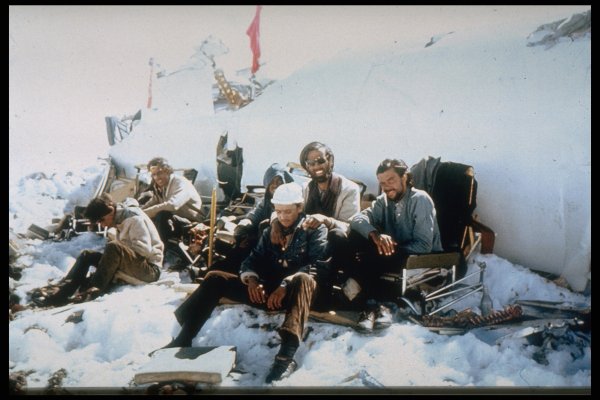
When looking at the story of a rugby team from Uruguay who crashes in the Andes mountains and turns to cannibalism to survive, many questions about the social construction of reality become apparent. Humans follow certain rules of society that, to us, our normal. Eating each other is off limits, whereas eating the meat of another animal is acceptable. Although we see the consumption of fellow humans as atrocious, when these rugby players are out in the mountains for over two months, many of these social constructions are no longer valid. They view those dead bodies as something different, once the survivors are left with few choices.

We, as human beings, have developed views and perceptions of many things that, to others, might be different. Just because we cannot understand how these sixteen people could turn to eating their own, doesn't mean that our social construction of reality would change once we were put in their shoes. Just because you cannot fathom opening up a person for surgery, that does not mean you couldn't after proper training and experience.

Tuesday, February 3, 2009

Cars, could you live without?


Several things have effected the way we live our lives in the past hundred years , but none to the extent that cars do. "The large-scale, production-line manufacturing of affordable automobiles was debuted by Ransom Olds at his Oldsmobile factory in 1902." (Wikipedia-Automobile)
We don't even think twice as we step into our metal giants and move down the streets. We don't realize the amount of convenience and comfort that these pieces of machinery provide. It seems that if you live anywhere other than a major city, you require transportation to merely go about your life. Most of us don't have a school or a grocery store or a hospital within walking distance.
Society has been developed around the assumed notion that cars will be available and people will drive them. Once the ideas of cars was assumed, we started to spread out our living spaces as our capabilities in mass transportation spread. We walk outside, turn a key, and take control of an object that can reach a speed of 100 miles per hour in less than fifteen seconds.
Since the early 1900's, we've also used design and looks to attract people. Many cars are sold for their looks rather than their efficiency. This need for cars to be socially acceptable or even to be used as a status symbol is very telling. The design of cars is very closely linked to a social aspect of life.
We take these objects for granted everyday, but without them, we would all be so very lost.